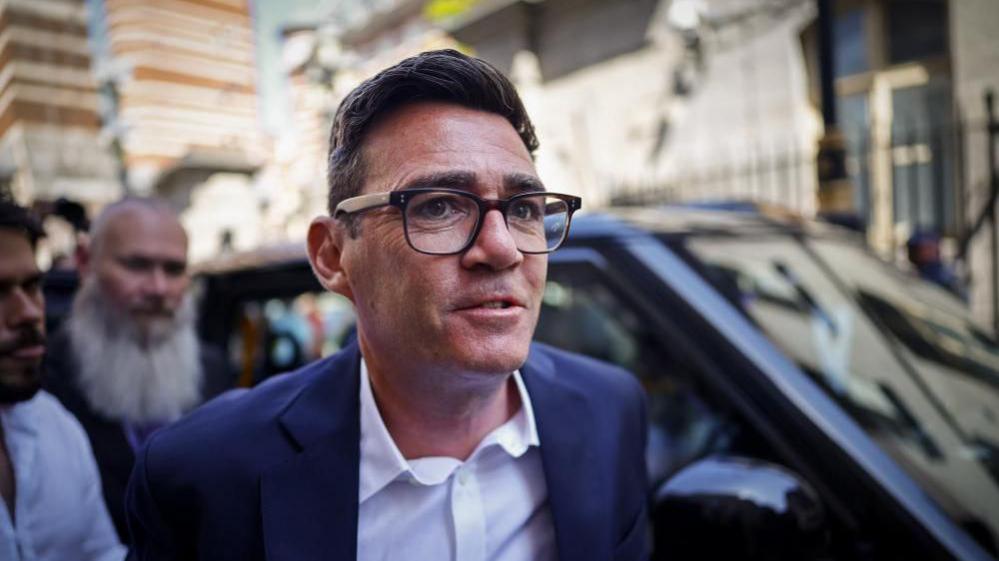
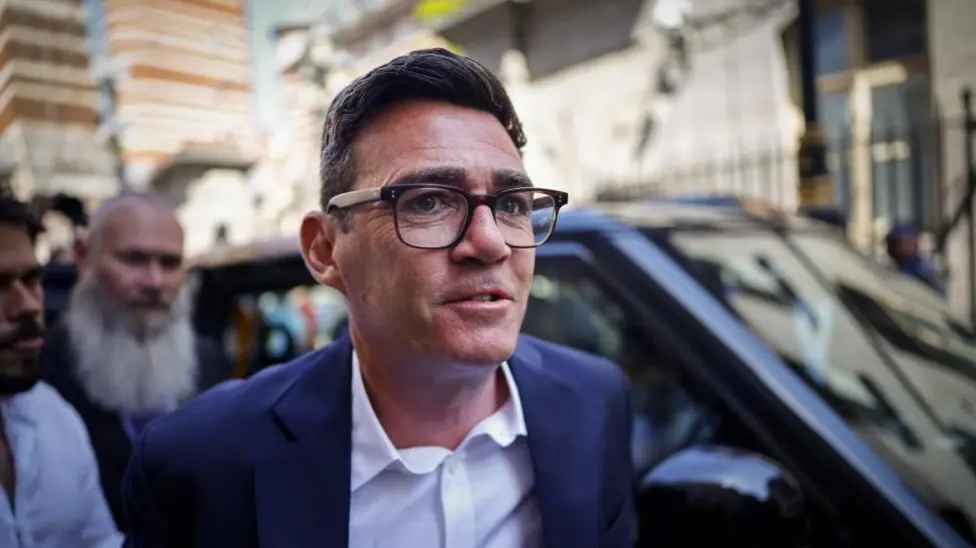
Andy Burnham will give what his team has called "his first major leadership speech" on Monday morning and will promise to "lift Britain back up to where it should be".
In an address at the People's History Museum in Manchester, the new MP for nearby Makerfield will say as prime minister he would "give Britain the circuit breaker it needs".
His inner circle describe it as "the foundational text" of his programme for government.
As such, it is expected to be broad based.
It is not thought he will take any questions from reporters afterwards, which will likely raise eyebrows from some given his lack of a mandate from the electorate.
His team insist this won't be part of "a pattern" of avoiding scrutiny - but that will come later in the campaign.
Central to his plans is handing more power to politicians beyond Westminster, in what is claimed would be "the biggest transfer of power out of Whitehall in modern times".
However, it isn't thought his ideas would be as significant as the setting up of the Scottish and Welsh parliaments and the Northern Ireland Assembly, nor the introduction of regional mayors in England.
Instead, it is expected that he will argue that nowhere near enough has been done to empower politicians outside London to do as much as they could.
Allies of the former mayor of Greater Manchester say Burnham's time in that job proved to him "how resistant Whitehall can be to devolution", as one put it, and that he wanted that to change.
One idea, described as a "flagship proposal", is the creation of what is being called a "No10 North" - with a part of the prime minister's operation being based in Manchester.
The aim is that this unit would be "to drive devolution" and it would be responsible for "good growth in every postcode" of the UK.
One source emphasised this wouldn't be about favouring the north of England - there would be attention paid to the other English regions and to Scotland, Wales and Northern Ireland, they said.
Burnham will also talk of his desire for what he calls "public control" of energy, water and transport - but a central question will be how much detail he offers about what he would want to do and on what timescale.
How much state intervention would he seek and how close might it be to nationalisation?
The Chairman of the Conservative Party, Kevin Hollinrake, said: "Andy Burnham's big idea is to shuffle power between politicians. Not fix the welfare system.
"Not cut the taxes strangling working families and British business. Not fund the defence our country desperately needs.
"Just more devolution, more committees, more process.
"It's the politics of distraction from a Labour Party that is deliberately avoiding the questions that actually matter."

Burnham's team say having sketched out his vision he will be able to continue to work out who he places in key roles in his cabinet.
A central dilemma for Burnham in the coming weeks is whether to appoint Energy Secretary Ed Miliband as his chancellor.
It is a live, ongoing discussion within his team.
They insist no jobs have been offered to anybody yet.
Some argue that Miliband, a former Treasury aide, has a clear political vision and the proven experience to drive change in a government department.
But his critics, of which there are many, variously see him as too left wing, too wedded to net zero targets and standing in the way of further development of oil and gas fields in the North Sea.
Another name also cropping up frequently in conversations is another Miliband - Ed's brother David, a former foreign secretary.
Ed Miliband beat his brother David to the Labour leadership in 2010.
David Miliband went on to move to the US and become the president of the International Rescue Committee.
Some wonder if Burnham might give him a seat in the House of Lords and hand him his old job back as foreign secretary.
Burnham faces an extraordinary three weeks ahead.
Three weeks today, he could become prime minister, assuming, as is widely expected, he doesn't face a contest for the Labour leadership.
In the next three weeks, he has to charm Labour MPs, sell his vision to the country, decide who will serve in his government and wrestle with the huge challenges that currently face Sir Keir Starmer.
How will he pay for our defence? What about social care? How will he manage his relationship with US President Donald Trump?
These are three of the dozens of huge questions that confront a man who wasn't even an MP a fortnight ago.

126 PerFlyer