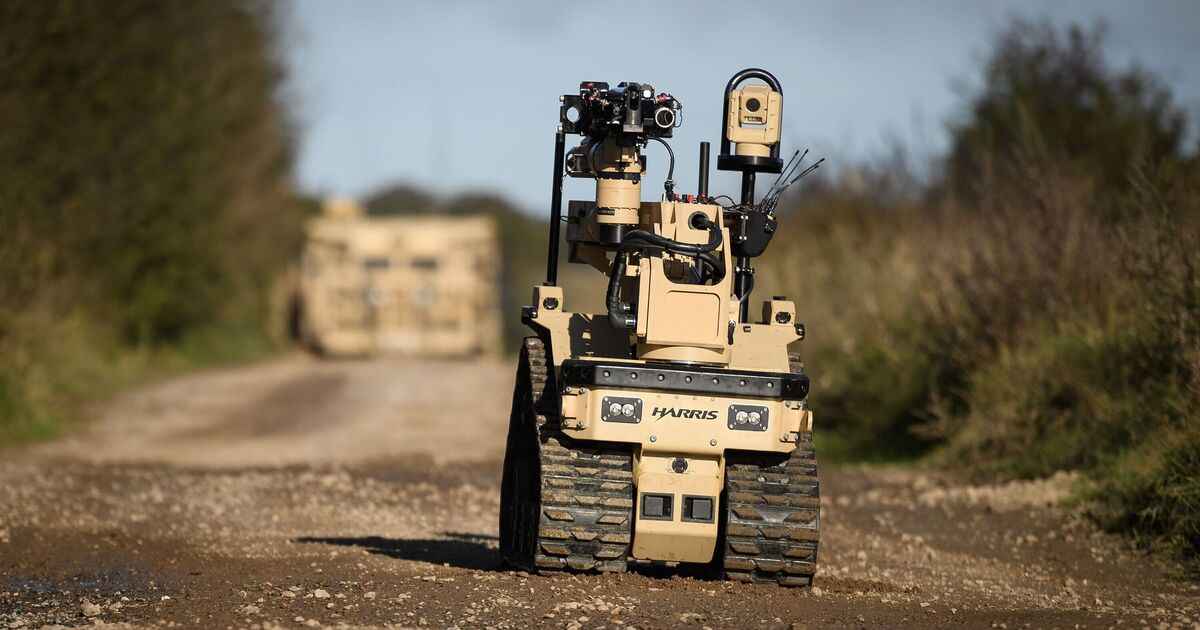

Britain’s armed forces are facing one of their most far-reaching restructures in decades as Labour’s Defence Investment Plan shifts billions of pounds towards autonomous weapons, artificial intelligence and long-range strike capability.
The strategy sets out an extra £15billion in defence spending over four years, lifting total investment to around 2.68 per cent of GDP by 2030, and accelerating a move away from traditional manpower-heavy operations towards machine-led warfare systems.
Manned tanks and infantry will increasingly operate alongside uncrewed platforms already proven on the battlefield in Ukraine, with officials arguing the nature of modern conflict is being permanently reshaped by rapid technological change.
The Royal Navy is expected to undergo the most dramatic overhaul, with First Sea Lord General Sir Gwyn Jenkins describing the future force as a “Hybrid Navy”, where conventional warships act as command centres for large fleets of autonomous systems operating across surface and subsea domains.
Similar restructuring will take place across the Army and Royal Air Force as Britain prepares to integrate AI-driven systems into frontline operations at scale.
The Defence Investment Plan lays out a sweeping reconfiguration of military spending priorities, backed by billions in new funding across land, sea and air capabilities, The Express understands.
Officials say the programme is designed to strengthen deterrence and ensure the UK can respond to rapidly evolving global threats, with lessons drawn from the war in Ukraine heavily shaping the direction of reform.
A central pillar of the plan is a £5billion investment in drones and uncrewed systems designed to operate across every branch of the armed forces, reports the Daily Mail.
These systems will be embedded into frontline operations on land, at sea and in the air, with artificial intelligence increasingly used to support targeting, surveillance and command decision-making.
The programme includes uncrewed missile barges known as Type 91 platforms, uncrewed submarines designated Type 93, and £230million allocated to autonomous seabed warfare systems designed to defend critical undersea infrastructure from attack.
The Royal Navy is being reshaped into a hybrid fleet model in which manned warships serve as control hubs for coordinated groups of autonomous vessels and underwater systems.
The UK is also deepening naval cooperation with Norway and the Netherlands as part of efforts to reduce costs and improve interoperability between allied fleets.
Under the Aukus partnership with the United States and Australia, Britain is also working towards a fleet of up to 12 nuclear-powered attack submarines.
Further investment includes £1.3billion for mine countermeasures and £120million for high-speed naval craft, reflecting a shift towards faster, more distributed maritime operations.
The Army is set to receive major investment in both traditional armoured capability and next-generation autonomous strike systems.
Funding includes £6billion for the Ajax armoured vehicle programme, £1billion to bring Ajax into operational service, £1billion for Challenger 3 tanks and £2.2billion for Boxer armoured vehicles, alongside £150million for uncrewed ground systems and £210million for long-range strike weapons and attack drones.
The shift signals a combined doctrine in which heavy armour is increasingly supported by remote, precision strike technology and autonomous battlefield systems.
The UK’s nuclear deterrent remains at the centre of national defence planning, with £63.6billion committed to long-term modernisation across submarines, warheads and supporting infrastructure.
The programme includes new attack submarines, replacement ballistic missile submarines, warhead development and upgrades to the nuclear fuel cycle.
The Defence Nuclear Enterprise is expected to support around 6,000 UK companies and 65,000 jobs by 2035, with the share of defence spending devoted to nuclear capability forecast to rise to between 20 and 25 per cent.
The plan states: “We are building new attack submarines, new ballistic missile submarines, new warheads and new infrastructure as well as a new nuclear fuels programme.”
It adds: “This work is a national endeavour with central and local government, industry and academia working together to deliver vital programmes.”
The Government will also maintain its “nuclear triple lock”, covering four Dreadnought submarines alongside warhead and infrastructure investment.
Britain’s air defence network will be expanded around Typhoon and F-35 fighter jets, which will continue to form the backbone of UK airspace protection.
A further £750million will go into counter-drone systems, including technologies such as Sky Hammer and Rapid Sentry, designed to intercept emerging aerial threats.
The number of Sky Sabre missile systems will also be doubled to reinforce short-range defensive coverage.
Additional funding includes £190million for short-range ballistic missiles and £400million for the Land Lethality Pipeline, aimed at significantly increasing Army firepower.
Special Forces funding will rise by 12 per cent, although exact capability allocations remain classified.
The plan also highlights expanded use of intelligence and data systems to improve battlefield awareness and accelerate threat detection.
The UK will continue its partnership with Japan and Italy on the £8billion Global Combat Air Programme, which will deliver a sixth-generation stealth fighter jet.
Despite earlier speculation over rising costs, the project remains a cornerstone of future RAF capability.
Apache helicopters will also be integrated with armed drone formations designed to operate alongside crewed aircraft in combat environments.
Investment in service accommodation has been pushed back, with a major regeneration programme covering around 14,000 properties now scheduled for completion between 2030 and 2035.
The delay affects Single Living Accommodation for unmarried personnel.
However, £470million will still be spent on upgrading base security, including measures linked to recent security concerns at UK military installations such as RAF Brize Norton.