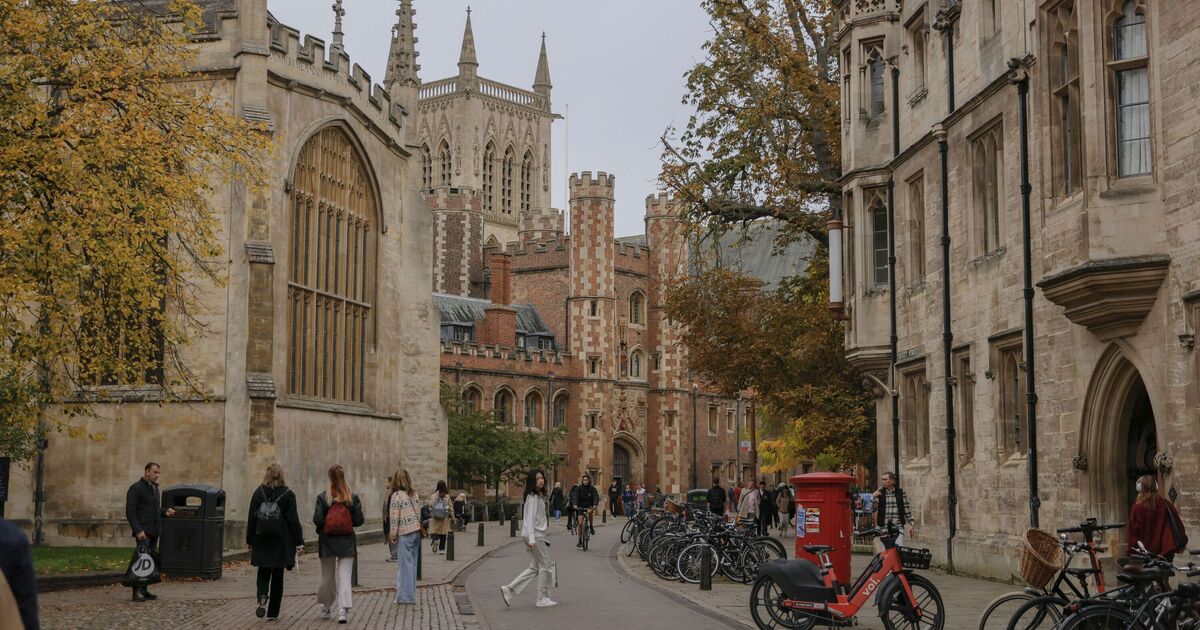

White working-class students are reportedly excluded from most diversity-linked scholarships at Oxford and Cambridge, according to a new analysis.
The review claims more than a dozen bursaries, scholarships and financial aid schemes across the two universities are available on the basis of ethnicity, rather than socioeconomic background.
It adds that while many of the schemes are open to Black, Asian and minority ethnic students, they largely exclude white working-class applicants, who are among the most under-represented groups in higher education.
The findings have prompted claims of a “two-tier academic society”, intensifying debate over how elite universities approach widening participation.
Reform UK education spokesman Suella Braverman criticised the existence of ethnicity-based schemes, arguing they risk undermining merit-based access.
She said: “Because of the Equality Act, white working-class families have been betrayed by a system that is designed to work against them and this is yet another example of two-tier academic society that punishes white working-class boys and girls because of who they are.
“If Oxford and Cambridge want to live up to their proud history of meritocracy, they should end these racially discriminatory programmes immediately and judge people on their talents, not their skin colour.”
The analysis conducted by The Telegraph, highlights a range of funding schemes at Oxbridge aimed at students from specific ethnic backgrounds, alongside broader outreach and access programmes.
At Cambridge, the Stormzy Scholarship, funded by the #Merky Foundation and HSBC UK, provides up to 10 Black UK students each year with £20,000 annually towards undergraduate study.
The university also offers an engineering-focused scholarship worth around £20,000 per year, which can support Black, Asian and minority ethnic students as well as women studying engineering.
Cambridge is also reported to run multiple postgraduate bursaries and doctoral funding schemes targeted at Black and minority ethnic applicants.
At Oxford, the Black Academic Futures scholarship can cover full course fees and provide additional living-cost support for eligible students, with similar schemes for British Bangladeshi and British Pakistani students.
Black and mixed-Black MBA students at Saïd Business School may also apply for the Oxford Black Leaders Scholarship, worth up to £30,000.
University College Oxford has also introduced its Univ Beacon Programme, offering undergraduate bursaries to Black, Asian and minority ethnic students, refugees, asylum seekers, care-experienced students, and members of Gypsy, Roma and Traveller communities.
Jesus College Oxford and other colleges also offer postgraduate studentships for Black and mixed-Black students, including full funding packages in some cases.
The Telegraph analysis also claims that a significant proportion of bursaries advertised via the UCAS system are targeted either at international students or specific ethnic groups.
It states that across UK universities, 19 institutions operate bursaries or scholarships specifically aimed at Black, Asian and minority ethnic students, while 11 offer schemes targeting asylum seekers and refugees.
Across Oxford and Cambridge, at least 15 diversity-linked scholarships and financial aid schemes are identified, covering undergraduate, master’s and doctoral students.
The universities also run a wide range of outreach programmes aimed at improving access for under-represented groups.
Writing in The Telegraph, a 20-year-old white student from a working-class background said the schemes had left him feeling disadvantaged in education and employment.
He said he was forced to turn down a place at a leading university after being excluded from financial support schemes on the grounds of ethnicity.
The student, who asked to remain anonymous, said he felt like a “second-class citizen”, adding that the “discrimination continues” through training schemes, internships and placements.
The analysis claims similar diversity-focused programmes exist beyond universities, including internships and schemes run by organisations such as GCHQ, MI5 and MI6, the Bank of England, major accountancy firms including Deloitte, EY, KPMG and PwC, as well as the Bar Council, the Greater London Authority and the Royal Society.
Under the Equality Act 2010, organisations are permitted to take “positive action” to address disadvantage or under-representation in education and employment.
Supporters of such schemes argue they are designed to widen participation and improve access for groups historically under-represented at elite universities.
Oxford and Cambridge have previously stated that their widening participation programmes aim to address disparities in higher education access.
The Telegraph analysis also claims white working-class students remain significantly under-represented at Oxbridge.
A 2019 report by the National Education Opportunities Network suggested they made up fewer than 3 per cent of students at Oxford and Cambridge.
By comparison, recent figures indicate that around 30 per cent of home students at Oxford in 2025 and 34 per cent at Cambridge in 2023 identified as Black, Asian or minority ethnic.
However, admissions data does not always capture full socioeconomic background, making direct comparisons more complex.